Asteroids, Earth-approaching

| (433) Eros is shown here in a photomosaic from NEAR Shoemaker while in orbit around Eros, taken 30 November 2000. Eros is one of the largest Earth-approaching asteroids with a length of 33 km. NEAR Shoemaker later landed on Eros in shadows just left of the center of this image. (Credit: NEAR, Johns Hopkins University Applied Physics Laboratory, NASA) |

| (1620) Geographos is shown here in a radar image from California's Deep Space Network at a range of 7,200,000 km, taken 30 August 1994. Geographos is 5 km by 2 km in size. (Credit: Steven J. Ostro, JPL, NASA) |

| (4179) Toutatis is shown in this image taken 13 December 2012 from the Chang'e 2 probe at a range of 3 km. Touatis is about 5 km by 2 km in size. Its dumbbell appearance may indicate that it is a loose "rubble pile" spun up a point of nearly fissioning into two bodies. (Credit: Xinhua) |
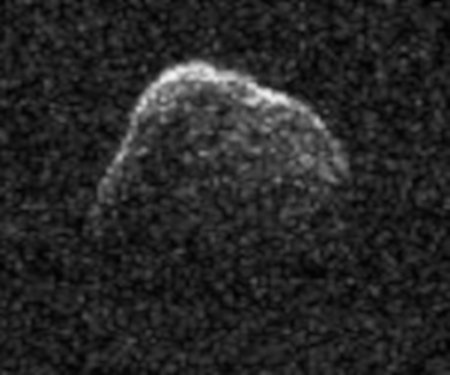
| (4660) Nereus is shown in this radar image taken 10 December 2021 from the Goldstone radar from 4,000,000 km away. It is about 330 meters across. (Credit: JPL, NASA) |

| (9969) Braille is shown as imaged by Deep Space 1 in July 1999. Sunlight is coming from the bottom of the image. (Credit: USGS, NASA) |

| (25143) Itokawa is seen here in an image taken in October 2005 by Japan's Hayabusa probe at several km range. Itokawa is about 320 meters across. This image clearly shows Itokawa to be a rubble-pile, a gravitationally-bound conglomeration of boulders and dust. (Credit: JAXA) |
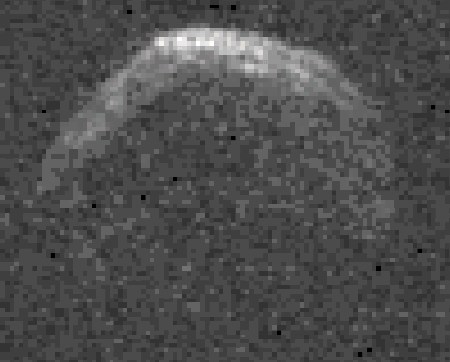
| (29075) 1950 DA is shown in this radar image taken 4 March 2001 from the Arecibo Observatory at a range of 8,000,000 km. 1999 JM8 is about 1.2 km in diameter. (Credit: Arecibo, JPL, NASA) |
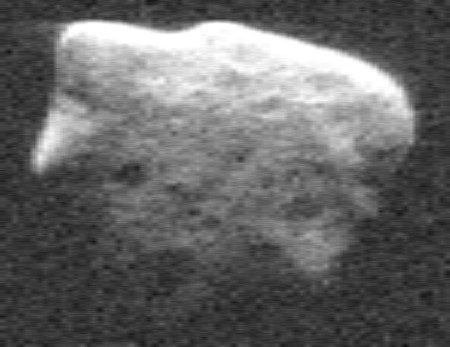
| (53319) 1999 JM8 is shown in this radar image taken 2 August 1999 from the Arecibo Observatory at a range of 8,500,000 km. 1999 JM8 is about 6 km in diameter. (Credit: Arecibo, JPL, NASA) |

| (65803) Didymos is seen here in an image taken by the DART spacecraft on 26 Sepetember 2022 from 290 km away. Didymos is a typical rubble pile asteroid about 760 meters in diameter. (Credit: NASA, Johns Hopkins APL) |

| Dimorphos, a moon of Didymos, is seen here in an image taken by the DART spacecraft on 26 Sepetember 2022 from 12 km away. Two seconds after this image was taken, DART impacted Dimorphos as an experiment in deflecting hazardous asteroids. (Credit: NASA, Johns Hopkins APL) |
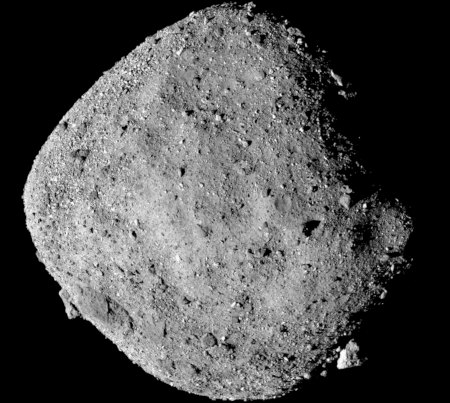
| (101955) Bennu is seen here in an image taken by the OSIRIS-REx spacecraft on 2 December 2018 from 24 km away. Bennu is 480 meters across. (Credit: NASA, Goddard, University of Arizona) |

| (162173) Ryugu is seen here in an image taken 26 June 2018 by Japan's Hayabusa 2 probe at 20 km range. Ryugu is about 900 meters across. Ryugu is a rubble-pile, a gravitationally-bound conglomeration of boulders and dust. (Credit: JAXA, Univ. of Tokyo, Kochi Univ., Rikkyo Univ., Nagoya Univ., Chiba Inst. Tech., Meiii Univ., Univ. of Aizu, AIST) |

| (308635) 2005 YU55 is shown in this radar image taken 9 November 2011 from the Goldstone radar from 300,000 km away. 2005 YU55 is about 360 meters across. (Credit: NASA, JPL-Caltech) |
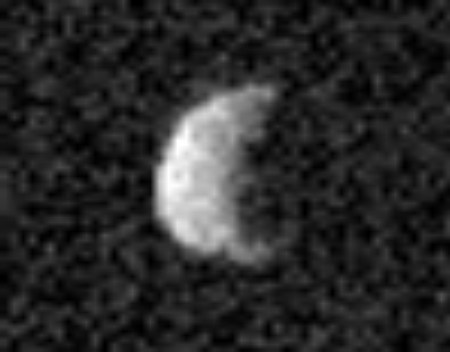
| (363116) 2001 GQ2 is shown in this radar image taken 29 April 2001 from the Arecibo Observatory. 2001 GQ2 is about 400 meters across. (Credit: Arecibo, JPL, NASA) |
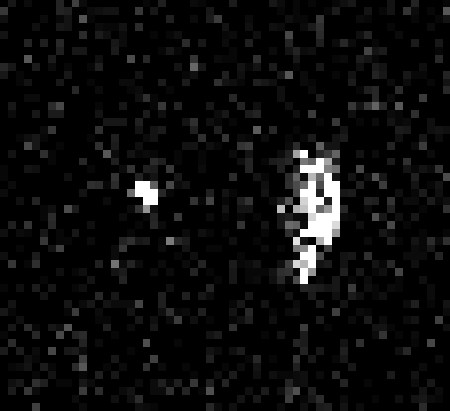
| (494658) 2000 UG11 is shown in this radar image taken 7 November 2000. 2000 UG11 is binary: the two components are visible here, 230 meters and 100 meters across, respectively. (Credit: Steven Ostro, JPL, NASA) |

| (620094) 2016 AJ193 is shown in this radar image taken in August 2021 from the Goldstone radar from over 2,000,000 km away. It is about 1.3 km across. (Credit: JPL, NASA) |
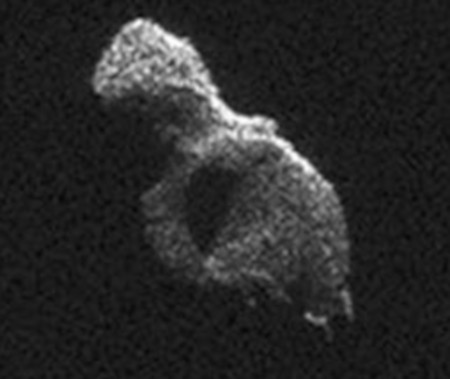
| 2014 HQ124 is shown in this radar image taken 8 June 2014 from the Goldstone and Arecibo radars from 1,400,000 km away. 2014 HQ124 is a contact binary about 380 meters by 200 meters across. (Credit: NASA, JPL-Caltech, Arecibo Obs., USRA, NSF) |
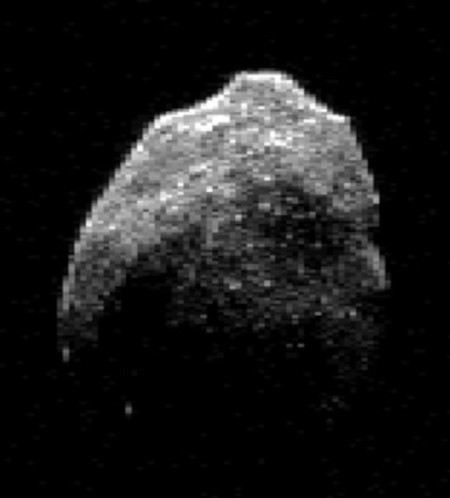
| 2015 TB145 is shown in this radar image taken 31 October 2015 from the Goldstone radar and Green Bank Telescope from 480,000 km away. 2015 TB145 is about 400 meters across. (Credit: NASA, JPL-Caltech, GSSR, NRAO, AUI, NSF) |
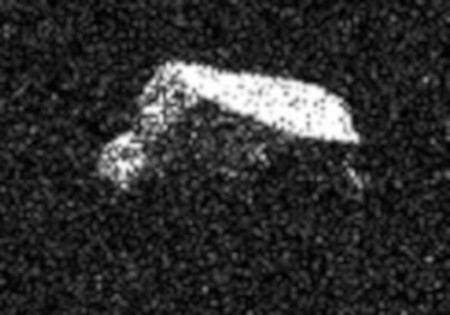
| 2017 BQ6 is shown in this radar image taken 7 February 2017 from the Goldstone radar from 2,500,000 km away. It is about 200 meters across. (Credit: JPL, NASA) |
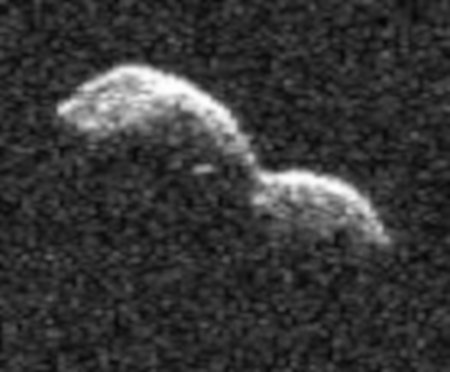
| 2024 ON is shown in this radar image taken 16 September 2024 from the Goldstone radar from over 1,000,000 km away. It is a contact binary about 350 meters long. (Credit: JPL, NASA) |
Text copyright © 2002-2018, 2025 by Wm. Robert Johnston. All rights reserved.
Last modified 20 June 2025.
Return to Home. Return to Astronomy and Space.